Middleton Space was founded in 2084 on the idea that the bottleneck in space wasn't rockets — it was everything that has to happen after the rocket. Cargo without a destination is just a launch. A destination without local construction and maintenance capability doesn't last.
So Middleton Space built backward from the end state: an orbital shipyard first, then the launch vehicles to feed it, then the surface operations and robotics to make the Moon a working site rather than a one-time visit. Colony is the next link in that chain.
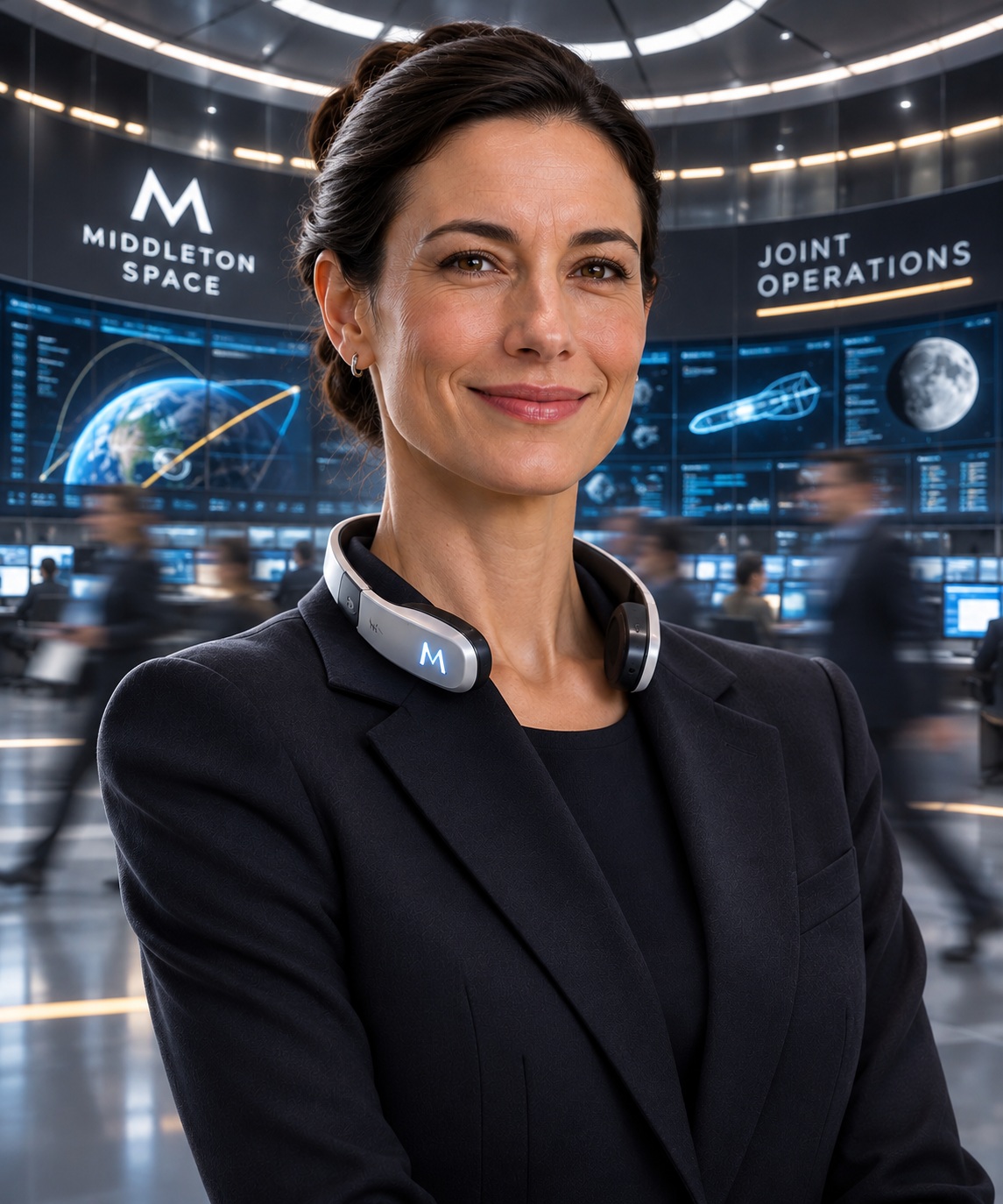
Natalie Carter in front of the entrance to Joint Ops Center
Get to know
Natalie Carter
Overnight Watch Commander.
Eight years with Middleton Space. Three years commanding the overnight watch. And preparing for the journey of a lifetime.
For Natalie Carter, the most exciting part of working at Middleton Space isn't necessarily the spacecraft, the technology, or even the prospect of traveling to another world. It's knowing that the decisions she makes every night help keep people safe.
Originally from Flagstaff, Arizona, Natalie grew up with an appreciation for the night sky. "You could drive twenty minutes outside town and see more stars than you could count," she recalls. "I never imagined I'd end up working for a company that was actually building ships to reach some of them."
Natalie joined Middleton Space eight years ago as an orbital operations analyst, bringing a background in aerospace systems and mission coordination. She quickly earned a reputation for remaining calm under pressure, asking the right questions, and recognizing problems before they became emergencies.
Five years into her career, she was promoted to Overnight Watch Commander at the company's Joint Operations Center (JOC) in South Texas, a position she has held for the past three years.
When Most of the World Is Sleeping
While much of the Middleton Space campus is quiet, Natalie's shift is just getting started.
As Overnight Watch Commander, she oversees the team responsible for monitoring spacecraft operations, orbital traffic, launch schedules, communications, and potential threats to Middleton Space missions. The JOC operates around the clock, maintaining continuous contact with spacecraft, orbital facilities, and other mission control centers.
"People sometimes think the overnight shift is quieter," Natalie says with a laugh. "It can be, right up until it isn't. Space operations don't follow a nine-to-five schedule. When something happens, you need people who can make decisions immediately."
Her responsibilities have become increasingly important as Middleton Space expands its operations beyond Earth orbit. The JOC now coordinates closely with government agencies and military operations centers, sharing orbital tracking information and responding to situations that can develop in minutes.
Natalie has earned the respect of her colleagues through her steady leadership and her willingness to take responsibility when difficult decisions must be made.
"I have an incredible team. They're smart, experienced, and they know their jobs. My responsibility is to make sure they have what they need and that we're all looking at the same problem. When things get complicated, you don't want twelve people trying to solve twelve different problems."
More Than a Job
Ask Natalie what she enjoys most about Middleton Space, and her answer comes without hesitation.
"The people. Absolutely the people. I've been here eight years, and I still look forward to coming to work. That's not something everyone gets to say."
She credits the company's culture with giving employees opportunities they might never find elsewhere.
"At Middleton, you're encouraged to learn things outside your normal responsibilities. If you're interested in something and you're willing to put in the work, somebody will help you figure out how to do it. I love that about this company."
That philosophy has taken Natalie in a direction she never expected.
From Orbital Operations to Growing Food on Another World
Natalie is among the Middleton Space employees selected to join a future colonization mission to TC7.
Her primary professional experience is in spacecraft operations, but every colonist is encouraged to develop practical skills that will contribute to life on the new world.
For Natalie, that means horticulture.
For the past eight months, she has been studying controlled-environment agriculture, with a particular emphasis on vertical farming, hydroponic systems, crop management, and food production in enclosed habitats.
"I knew almost nothing about growing food when I started," she admits. "I grew up in Arizona. Keeping a houseplant alive was about the extent of my experience."
Her training includes classroom instruction, simulated agricultural environments, and hands-on work with the company's experimental growing systems.
"Now I'm learning about nutrient balances, lighting cycles, water recovery, and how to grow vegetables in stacked systems without soil. It's fascinating. And the instructors are patient, which is fortunate because I've asked some pretty basic questions."
She pauses, smiling.
"I'll miss the JOC on Earth. I've spent eight years here, and these people are like family. But I've been learning vertical farming for eight months now, and I still can't believe the opportunity. I'm actually preparing to grow food on another planet. How many people in history have ever been able to say that?"
Looking Toward TC7
Natalie knows the transition won't be easy. Leaving Earth means saying goodbye to familiar places, routines, and many of the people who have been part of her life.
But she sees the mission as an opportunity to contribute to something much larger than herself.
"There's a lot I'll miss. Flagstaff, for one. My friends, the mountains, even the weather. And I'll definitely miss walking into the JOC and seeing my team."
She laughs.
"Although I might not miss the two-in-the-morning emergency calls."
For now, Natalie remains focused on her responsibilities at the Joint Operations Center while continuing her agricultural training. She hopes the skills she's developing will make her a valuable member of the TC7 community, regardless of what her eventual assignment may be.
"I love Middleton Space. I love what we're doing here. And I think the most remarkable thing about this company is that it doesn't just talk about the future. It gives ordinary people a chance to help build it."
Eight years ago, Natalie Carter joined Middleton Space to help manage missions beyond Earth. Her next assignment may be helping humanity put down roots on another world.
Get In Touch
Talk to Middleton Space.
Press, partnership, and career inquiries welcome at our Houston headquarters.